
It Shouldn’t Take a Pandemic to Fund Mental Health Services In Schools
By Mariana Ramirez
The Covid 19 pandemic was a formative aspect of my high school experience and fundamentally changed the services that were provided. With many students facing the challenges from isolation, the growing mental health struggles and lack of support could no longer be overlooked. As a freshman there was only one counselor on campus, whose role was focused mainly on addressing behavioral issues with students. In most cases, the counselor was only brought in for mediation between students;other staff not a reliable or even accessible source of support. It became clear that the counselor was not there to act as a therapist or to actually address the needs of the students that could very much prevent issues before they escalated. Instead, the counselor was brought in only in situations that had already reached a breaking point, in which they were mandated to intervene.
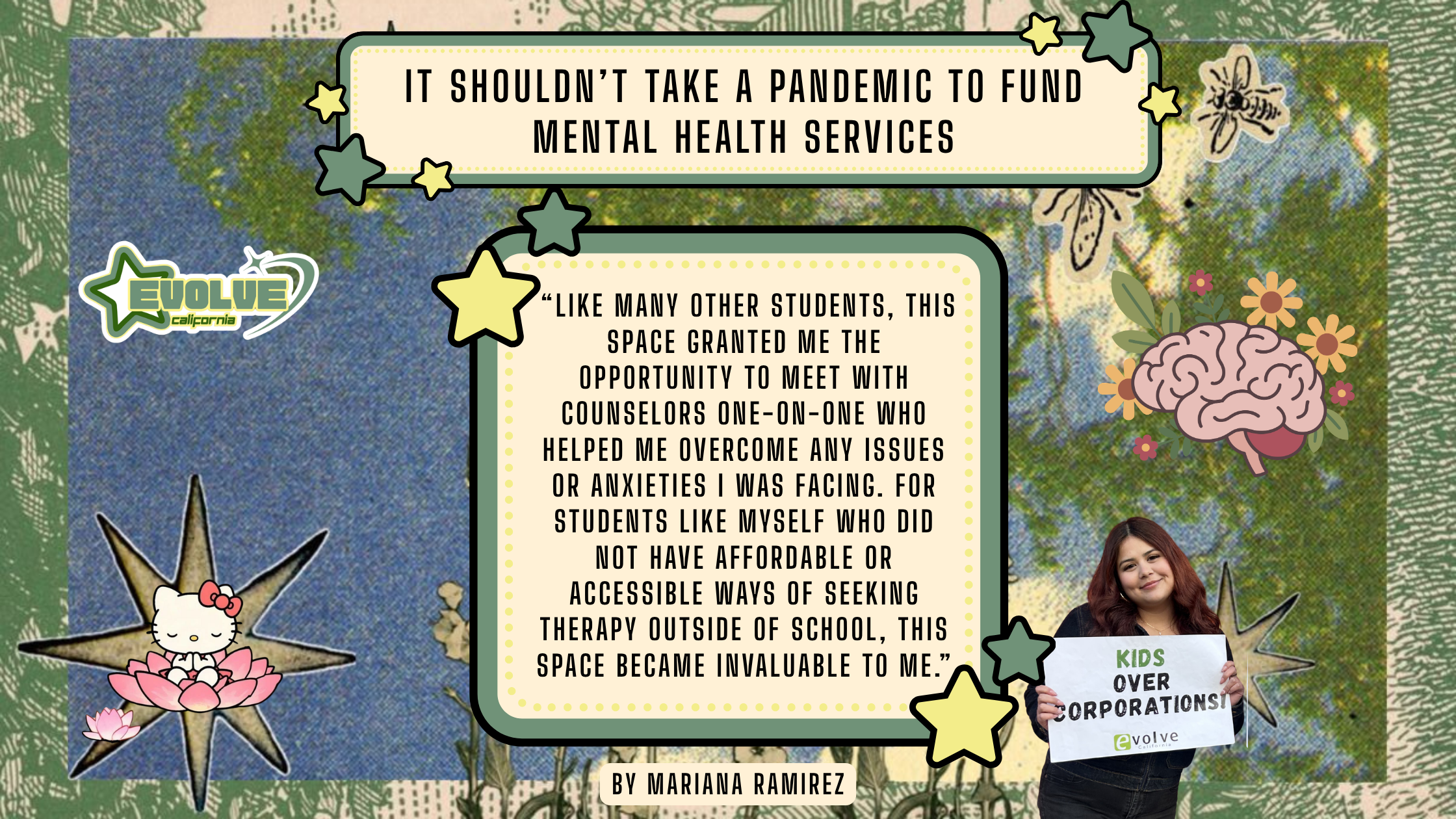
However, post-pandemic, students' needs became impossible to ignore. This resulted in the development of the “Wellness Center’”on campus, as the school finally allocated enough funding to create a space centered on supporting the mental health of its students. The “Wellness Center” was staffed by three full-time counselors and additional support staff who became crucial to most students' daily lives. Like many other students, this space granted me the opportunity to meet with counselors one-on-one who helped me overcome any issues or anxieties I was facing. For students like myself who did not have affordable or accessible ways of seeking therapy outside of school, this space became invaluable to me. For the first time in our academic lives, students could take refuge in and take time to collect themselves and reset. This not only had a positive impact on improving student mental health, but it also serves as a form of prevention. Rather than waiting until situations escalated, students were able to access support early on. In this way, it became a vital third space on campus where students could feel safe, supported, and protected.
Despite knowing that students have always needed support and the cost of not addressing these disparities, it begs the question on why it took a pandemic for the schools to finally invest in mental health services. But the truth is we already know why it took so long. Funding disparities are at the root of issues within schools and the lack of services they can provide. For most schools these mental health spaces are not even tangible due to budget constraints as itrequires much funding to create these spaces and even more funding to staff these facilities with qualified individuals who can provide mental health services. Despite the clear difference these programs make, many schools can barely afford to employ one counselor let alone three. This inevitably leads to counselors who are spread thin and can not address the needs of hundreds to thousands of students.
The root of many of these funding disparities is Proposition 13. After passing nearly five decades ago, this piece of legislation single handedly slashed education funding, stripping nearly 17 billion every year. Although it was first introduced as a way to protect homeowners, it has since led to tragic consequences. It has enabled corporations to exploit its loopholes and dodge paying their fair in taxes for on large, highly profitable commercial properties. With proper funding, schools would have had far more resources to meet the needs of their students. These inequities make reform that much more crucial, as it would not only uplift schools in funding, but would equip them with resources to invest in mental health services needed for students to THRIVE.